← Back to all use cases Industry

Manufacturing & industry

Unplanned downtime turns production problems into expensive surprises.

Pilot targetLess downtime and scrap
Project startDate agreed in scope
ValidationMeasured against baseline
What changes

From production signals to a measurable plant workflow.

Pilot targetLess downtime and scrap
01Today

The friction

Machines fail without warning, quality defects are caught after the batch is finished, planning lives in spreadsheets, and paperwork from suppliers and customs is typed in by hand. Nobody has a live picture of what the plant is actually doing.

02With HAY AI

The operating change

Use available machine, production and inspection data to support maintenance prioritisation, quality review and production planning. Validate signals on one line first; engineers approve maintenance, operating changes and quality release.

Best fit

Factories, processing plants and industrial suppliers.
Decision snapshot

Start with one production line and one defect type.

Start with one workflow, measure it against the current baseline and expand only after the result is visible.

See a sample first pilot →
Best first pilotVisual quality inspection on one production line.
What we measureDetection quality, false accepts/rejects, inspection time and rework.
Human controlOperators validate exceptions and retain stop/release authority.
Scale ruleKeep, improve or stop the pilot based on evidence before expanding.
Smart Manufacturing & industry roadmap

From production signal to quality, maintenance and throughput action

Use AI where it can surface patterns earlier while operators retain stop, release and safety authority.

What happens today
Machines fail without warning, quality defects are caught after the batch is finished, planning lives in spreadsheets, and paperwork from suppliers and customs is typed in by hand. Nobody has a live picture of what the plant is actually doing.
Roadmap

See the operating journey stage by stage.

Open each stage to see the problem, action, deliverable and KPI behind the workflow.

Manufacturing & industry roadmap

Stage 1 of 7

Demand & planning

More reliable planning with fewer surprises
The problem at this stage

Orders, forecasts, inventory and production capacity are managed in separate spreadsheets. Demand changes reach the factory late, so teams overproduce some items while missing delivery commitments for others.

Exactly what we do

Connect orders, historical demand, inventory, capacity and lead-time data. Create a rolling forecast, compare production scenarios and give planners an explainable schedule with the assumptions behind it.

What you receive

Demand forecast, capacity view, production plan, scenario comparison and alerts when demand or delivery risk changes.

Opportunity map

Eight practical areas we can improve

See maintenance, quality, production planning and shop-floor reporting as connected manufacturing workflows rather than separate AI experiments.

1. Demand & planning

Connect orders, historical demand, inventory, capacity and lead-time data. Create a rolling forecast, compare production scenarios and give planners an explainable schedule with the assumptions behind it.

2. Materials & supply

Track material availability, supplier performance and lead times in one view. Recommend reorder points and purchase timing, flag supplier risk and process supplier documents with human approval for commitments.

3. Production execution

Optimise the production sequence against demand, capacity, changeovers and material availability. Give operators clear work-order guidance, surface bottlenecks and escalate exceptions to the right supervisor.

4. Quality control

Combine inspection records, machine data and quality rules, use computer vision or anomaly detection where appropriate, flag defects early and maintain a digital batch and corrective-action trail.

5. Maintenance

Use machine signals, downtime history and maintenance records to identify failure patterns, prioritise work orders by risk and production impact, and alert the team before a likely failure.

6. Warehousing & delivery

Connect warehouse and transport events, recommend picking and loading priorities, flag inventory or delivery exceptions and send accurate proactive status updates to the responsible team and customer.

7. Analysis & improvement

Create one operations dashboard, explain the drivers behind KPI changes, identify recurring losses and run focused improvement experiments with a before-and-after comparison.

8. Continuous improvement

Bring downtime, quality exceptions, maintenance actions and production signals into one recurring operations review so the next intervention is clear.

Choose your first pilotRecommended starting point

Visual quality inspection on one production line.

Start with one line and one defined defect type. Use labelled examples and operator review to compare inspection quality and speed with the current process before expanding.

What we build

  • Define one defect type, acceptance criteria and the current inspection baseline
  • Capture approved camera or inspection images from one production line
  • Configure and test the vision inspection workflow with confidence thresholds
  • Add operator review, defect logging and escalation for uncertain cases

How we measure it

  • Detection quality against labelled samples
  • False accept and false reject rate
  • Inspection time per unit or batch
  • Operator review workload and rework
Next expansion

What to add after the pilot

After the visual-inspection pilot proves useful, expand one capability at a time instead of bundling unrelated plant workflows into the first scope.

Predictive maintenance

Use machine-health and maintenance history to test one alerting workflow on a critical asset group.

Production planning & scheduling

Connect orders, inventory and capacity to a focused planning workflow with planner approval.

Materials, reorder & documents

Add replenishment recommendations, supplier-document handling and shortage visibility as a separate expansion.

Why this works

Practical before ambitious.

We begin with one measurable production constraint, keep engineers and operators responsible for decisions and expand only after the first workflow proves reliable in practice.

Current methodBaselineMinimum systemsHuman approvalScale after proof
AI in action

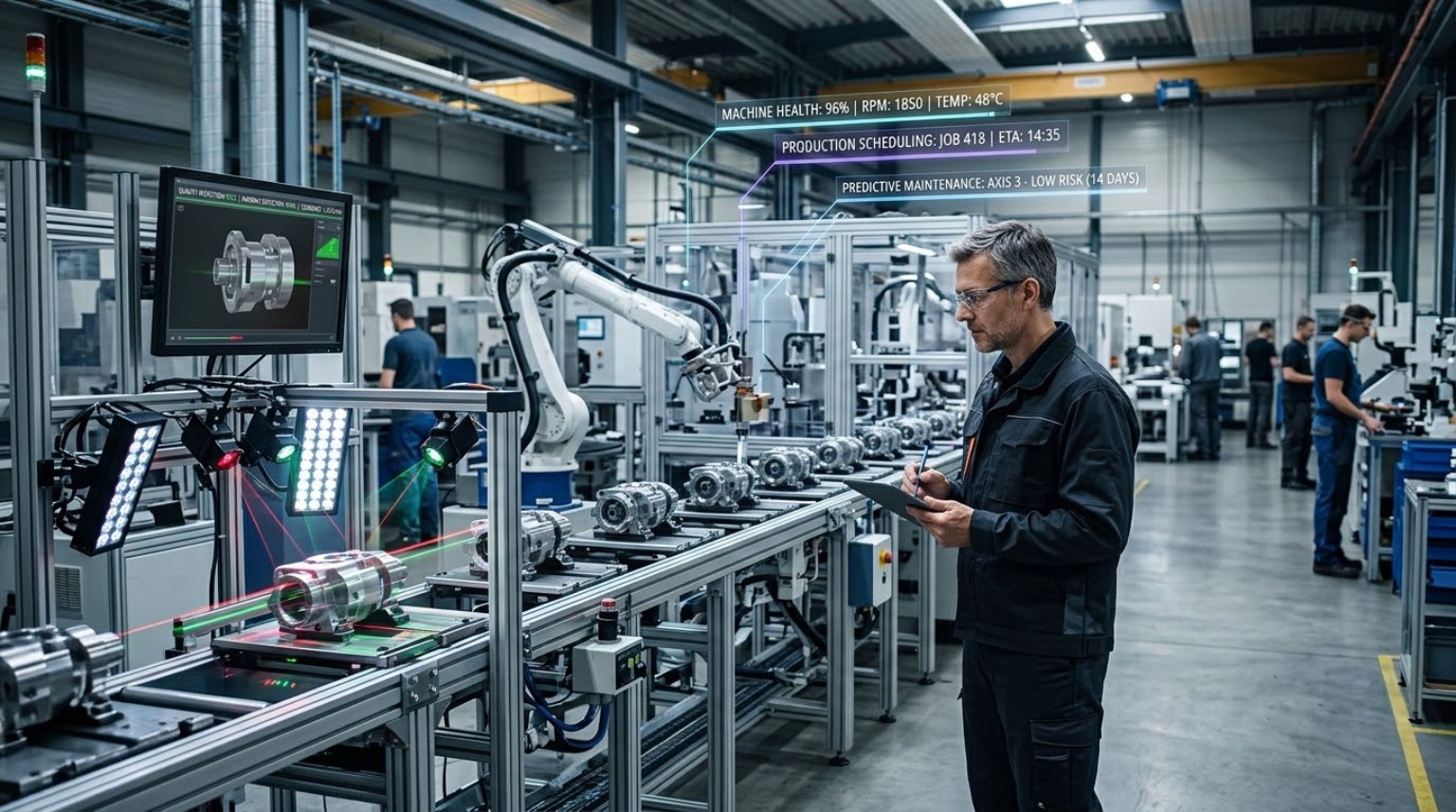
See how one production signal becomes an engineer-reviewed action

Give engineers earlier maintenance signals and a clearer production view, with people approving operational changes.
Manufacturing and industry production line with engineer oversight, computer-vision inspection, machine health monitoring and predictive maintenance

Why this approach works for Manufacturing & industry

Start small, then connect

Choose one line, machine group or quality workflow and one measurable target first. Expand only after operators and engineers accept the process and production evidence is visible.

Keep people in control

Operators validate exceptions and retain stop/release authority.

Use the tools already in place

Connect approved MES, CMMS, quality records, sensor feeds and production spreadsheets where practical instead of replacing plant systems.

Measure business outcomes

Review the agreed measures: Defect escape rate, downtime, inspection time and rework. Use these to assess business outcomes and decide the next step.

Manufacturing & industry project process

1. DiscoveryInterview the owner, process lead and people who do the work today.
2. BaselineMeasure time, volume, quality, cost, delays or missed opportunities.
3. Build the pilotConfigure one focused workflow and connect only the data required for the first result.
4. MeasureCompare the pilot with the baseline and review adoption, quality and risk.
5. Decide and scaleKeep, improve or stop the pilot based on evidence, then connect the next stage.
6. Improve regularlyTurn the connected reporting into a recurring operating rhythm for the team.

Suggested start: one workflow can go live first; the next measurable improvement is added only after the first review.

Information we need

  • Current workflow, owner and handoffs
  • Three to six months of relevant examples, records or messages
  • The systems, files, channels and approvals involved
  • Current baseline for Defect escape rate, downtime, inspection time and rework.
  • The person responsible for exceptions and final decisions

Initial diagnostic questions

  • What is the biggest manufacturing & industry bottleneck today?
  • How often did it happen last month?
  • What do downtime, defects, manual checks, schedule disruption or maintenance delays cost today?
  • Which system or data already records the problem?
  • Can the first pilot run on one line, asset group, shift or quality workflow?

Not sure which one fits you?

Book a free 30-minute discovery call. We will identify which use case is worth testing first and what evidence should decide the next step.

Book a free 30-minute discovery call

Other areas we automate

Contact us

Have a question about this page?

Send us the workflow, problem or idea you want to discuss. We’ll reply within one business day.

HAY AI Assistant

English · Հայերեն · العربية · Русский · Español