← Back to all use cases Retail

Retail & e-commerce

Product, inventory and customer signals rarely arrive in one decision-ready view.

Pilot targetHigher conversion per visit
Project startDate agreed in scope
ValidationMeasured against baseline
What changes

From catalogue friction to a measurable retail workflow.

Pilot targetHigher conversion per visit
01Today

The friction

Catalogues are incomplete, product copy is thin and identical across markets, recommendations are generic, and stock decisions are made from last season's spreadsheet rather than real demand signals.

02With HAY AI

The operating change

Improve catalogue content and product discovery using approved product data. Connect stock and order information where integrations allow, and test recommendations or demand forecasts against a baseline. Staff approve purchasing and pricing changes.

Best fit

Online and omnichannel retailers.

Decision snapshot

Start with one category or one product-discovery journey.

Start with one workflow, measure it against the current baseline and expand only after the result is visible.

See a sample first pilot →
Best first pilotProduct discovery and recommendation for one category.
What we measureConversion per visit on the tested discovery flow, Recommendation or search relevance on an agreed test set, Discovery engagement for the selected category, Basket value for sessions using the tested flow.
Human controlMerchandising and pricing rules remain configurable by the team.
Scale ruleKeep, improve or stop the pilot based on evidence before expanding.
Smart Retail & e-commerce roadmap

From product discovery to fulfilment and loyalty

Improve the buying journey while keeping merchandising, pricing and inventory decisions configurable by the team.

What happens today
Catalogues are incomplete, product copy is thin and identical across markets, recommendations are generic, and stock decisions are made from last season's spreadsheet rather than real demand signals.
Roadmap

See the operating journey stage by stage.

Open each stage to see the problem, action, deliverable and KPI behind the workflow.

Retail & e-commerce roadmap

Stage 1 of 7

Demand understanding

Clearer demand signals and better planning
The problem at this stage

Retail decisions are made from disconnected sales, search, customer, social and seasonal signals. The team cannot reliably see what shoppers want, which trends are growing or where demand will be lost.

Exactly what we do

Connect customer, catalogue, sales and channel signals, segment shoppers by need and intent, identify trends and create a practical demand baseline for planning.

What you receive

Demand map, shopper segments, trend signals, forecasting baseline and a prioritised list of growth opportunities.

Opportunity map

Eight practical areas we can improve

See catalogue quality, merchandising, inventory and customer journeys as connected retail workflows so improvements can be measured across the same operating picture.

1. Demand understanding

Connect customer, catalogue, sales and channel signals, segment shoppers by need and intent, identify trends and create a practical demand baseline for planning.

2. Supply & inventory

Combine sales, stock, supplier, lead-time and warehouse data, forecast demand by product and location, recommend reorder points and flag shortages or excess inventory early.

3. Pricing & offers

Recommend price and promotion options from demand, margin, inventory and segment signals. Apply approval rules, protect minimum margin and measure the result of each offer.

4. Sales & conversion

Deploy personalised recommendations and an AI shopping assistant, improve product discovery, detect cart and browse abandonment, and trigger relevant recovery messages with customer consent.

5. Delivery & experience

Connect order and delivery events, show reliable status and ETA, alert the team to exceptions, send proactive updates and route problems to the right owner before the customer has to ask.

6. Loyalty & retention

Segment customers by value, behaviour and lifecycle, personalise rewards and replenishment reminders, identify declining engagement and launch retention journeys with clear opt-out controls.

7. Analysis & growth

Create one decision dashboard across sales, margin, inventory, marketing and customer behaviour. Review cohorts and product performance, test one improvement at a time and keep the changes that produce measurable growth.

8. Continuous improvement

Bring catalogue completeness, merchandising actions, inventory signals and journey performance into one recurring retail review so the next intervention is clear.

Choose your first pilotRecommended starting point

Product discovery and recommendation for one category.

Start with one product category and one discovery surface. Use approved catalogue attributes and merchandising rules to improve search or recommendations, then compare relevance and conversion signals with the current baseline.
What we build

  • Choose one product category, discovery surface and current conversion or engagement baseline
  • Prepare the approved catalogue attributes, availability signals and merchandising constraints required for matching
  • Configure search or recommendation logic for that category with explainable merchandising controls
  • Run the pilot with a defined user segment and give merchandisers a review view for poor matches or exceptions

How we measure it

  • Conversion per visit on the tested discovery flow
  • Recommendation or search relevance on an agreed test set
  • Discovery engagement for the selected category
  • Basket value for sessions using the tested flow
Next expansion

What to add after the pilot

After discovery quality is proven, expand one retail capability at a time.

Catalogue enrichment

Generate and review missing attributes or descriptions as a separate data-quality workflow.

Inventory & demand forecasting

Add stock and demand models only after the relevant operational data is ready.

Customer-service assistant

Use approved product and policy knowledge for support as a separate customer-service pilot.

Why this works

Practical before ambitious.

We begin with one measurable retail bottleneck, keep merchandising and commercial teams in control and expand only after the first result is visible in operating data.

Current methodBaselineMinimum systemsHuman approvalScale after proof
AI in action

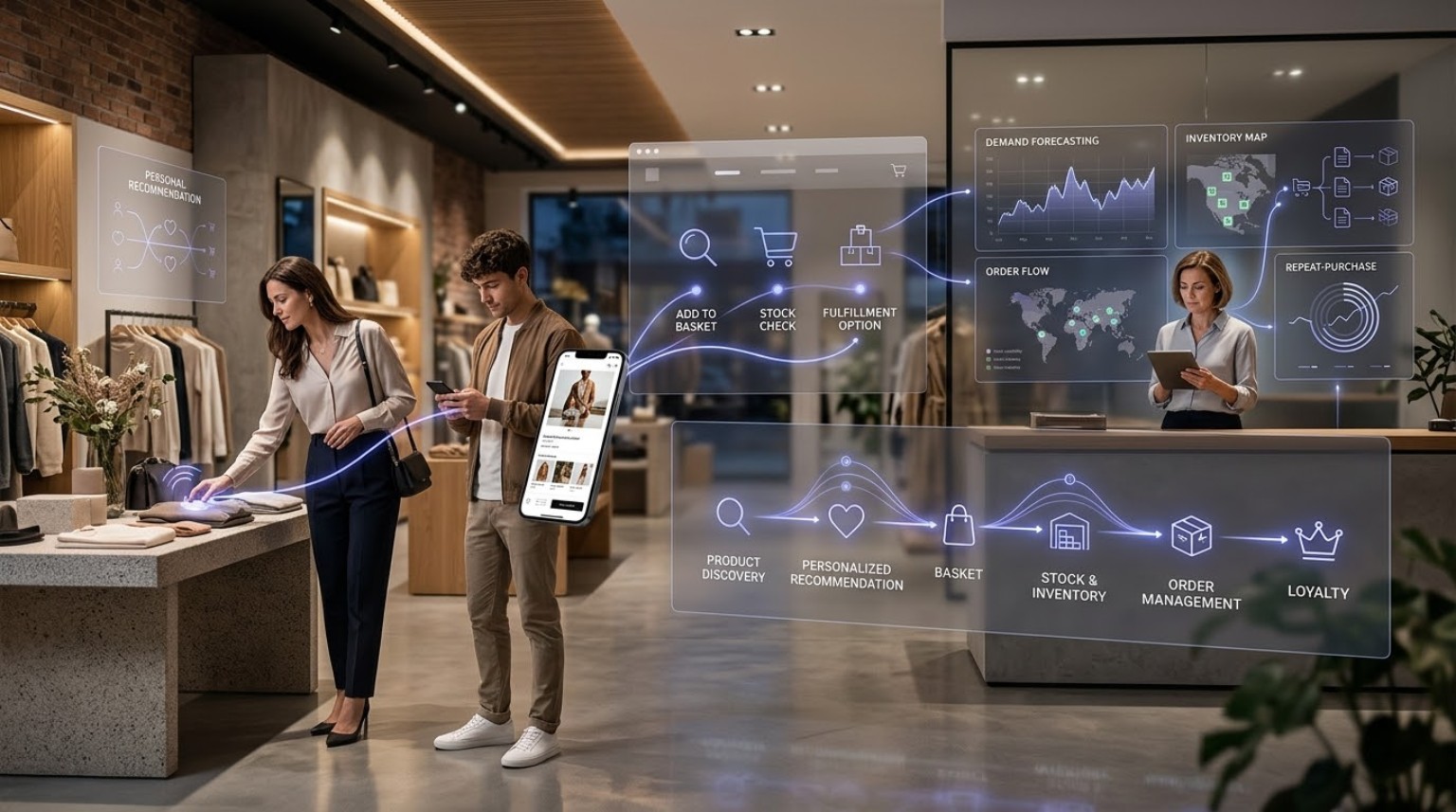
See how product data becomes a better discovery and inventory signal

Connect product discovery, stock availability and order updates to help customers find what they need and staff resolve exceptions.
Retail and e-commerce scene with shoppers in a modern store, mobile shopping, inventory intelligence, fulfillment flow and loyalty analytics

Why this approach works for Retail & e-commerce

Start small, then connect

Choose one catalogue, merchandising or customer-journey workflow and one measurable target first. Expand only after commercial teams accept the process and evidence.

Keep people in control

Merchandising and pricing rules remain configurable by the team.

Use the tools already in place

Connect the commerce platform, PIM, CRM, analytics, inventory and support tools already in use rather than creating another retail data silo.

Measure business outcomes

Review the agreed measures: Conversion, basket value, stock-outs and repeat purchase. Use these to assess business outcomes and decide the next step.

Retail & e-commerce project process

1. DiscoveryInterview the owner, process lead and people who do the work today.
2. BaselineMeasure time, volume, quality, cost, delays or missed opportunities.
3. Build the pilotConfigure one focused workflow and connect only the data required for the first result.
4. MeasureCompare the pilot with the baseline and review adoption, quality and risk.
5. Decide and scaleKeep, improve or stop the pilot based on evidence, then connect the next stage.
6. Improve regularlyTurn the connected reporting into a recurring operating rhythm for the team.

Suggested start: one workflow can go live first; the next measurable improvement is added only after the first review.

Information we need

  • Current workflow, owner and handoffs
  • Three to six months of relevant examples, records or messages
  • The systems, files, channels and approvals involved
  • Current baseline for Conversion, basket value, stock-outs and repeat purchase.
  • The person responsible for exceptions and final decisions

Initial diagnostic questions

  • What is the biggest retail & e-commerce bottleneck today?
  • How often did it happen last month?
  • What do incomplete catalogue data, weak discovery, service effort or lost conversion opportunities cost today?
  • Which system or data already records the problem?
  • Can the first pilot run on one category, store, segment, channel or customer journey?

Not sure which one fits you?

Book a free 30-minute discovery call. We will identify which use case is worth testing first and what evidence should decide the next step.

Book a free 30-minute discovery call

Other areas we automate

Contact us

Have a question about this page?

Send us the workflow, problem or idea you want to discuss. We’ll reply within one business day.

HAY AI Assistant

English · Հայերեն · العربية · Русский · Español